Saturday, June 17, 2006

Boycott Disney, Pirates of the Caribbean

Starting in February of 2005, we began to post a number of items regarding Walt Disney's proposed plans for showing Island Caribs as blood thirsty man eaters. In Dominica, where parts of the film were shot, then Carib Chief Charles Williams loudly protested the movie and condemned select members of the Carib Territory for collaborating with Disney. The Government of Dominica warmly welcomed Disney, guided by the incredible notion that a media giant showing local natives as cannibals would promote tourism to the island. The movie was also shot in St. Vincent. Since then, Chief Williams was deposed by the Government of Dominica (although to what extent Williams embarrassing the government over this issue played any role in the government's decision is unclear for now). Other indigenous communities, including Tainos, Garifuna, and the Caribs of Trinidad, also vigorously protested the movie in the news media. Indian Country Today in the United States ran an editorial that was very critical of Disney's plans.

Now, the movie is about to hit theaters and, if anything, it appears to be worse than was first imagined. A trailer for the film clearly shows the Caribs roasting live people on spits and holding captives to be eaten...in a stark reminder of some of the most vile imperialistic imagery produced in the early colonial era. Such images are getting a new lease on life thanks to Disney, which with the resources that rival those of a colonial power, has now dedicated itself to popularizing and internationalizing images of the Caribs as "cannibals". You can see the movie trailer at: http://www.youtube.com/watch?v=dAx02SQ5Mjs&mode=related&search=pirates%20of%20the%20caribbean%20dead%20mans%20chest. Images that follow are stills from the trailer, accompanied by one colonial illustration that seems to have been part of the corpus of visual imperial denigrations that the movie so cheerfully enhances.

Let us keep in mind that such depictions were used to enslave and murder the ancestors of today's Caribs, there was never anything innocent or "fun" about these portrayals. In addition, generations of Carib descended school children in the Caribbean have been taught that their ancestors were savage cannibals. Shame over ancestry was inculcated as a matter of routine. In my own field research experience, I have encountered individuals in their forties and fifties who told me very directly that the main reason they did not wish to self-identify as Caribs is that people in the wider world see Caribs as cannibals, as inhuman man eaters, and they found the stigma unbearable. Disney is playing its part in centuries of ethnocide.

This action on the part of Disney, flying in the face of countless protests, is not accidental, nor just uninformed carelessness. Let's place these images in their current context as well. This is a time of renewed generalizing about the "non-West" as the "uncivilized" world of inhumane acts of savage atrocities. Anti-immigrant attitudes are on the rise in many Western countries. Anyone "brown-skinned" is deemed a potential terrorist. This is not inflammatory exaggeration on my part: for a glimpse at the tip of the iceberg, look at reports produced within the Canadian media itself:

Many white citizens adjoining Native reserves seem to feel empowered now to express openly derogatory views about Natives, even joining in the occasional riot where they can bash some in the face. A peaceful gathering of Natives in Canada is widely depicted as "terrorism". You don't believe me? Please have a look at pages from the Caledonia Citizens Alliance where members of the public submit their feedback on the issue of the Native reoccupation of their territory.

Images specifically of charred bodies, hung like roasted offerings, have also been popularized in the international press, especially when showing the "horrid" acts of Iraqi insurgents in Fallujah who captured and killed four American mercenaries in March of 2004.


All of the raw material, daily news, centuries of inherited stereotypes, revived bigotry, fear, hatred and paranoia are all out there ready to be fused in people's minds who are thus predisposed to making a series of associations. One line of association is that linking Al Qaida with all Muslims, then immigrants, "brown skin," Natives, and finally Caribs. The other line of associations to complement the first: terrorism, insurgence, resistance and cannibalism.

This is the world we are inheriting, folks! Either we deal with these issues head on, or sit back and let the tide of a new nazism wash over us with the help of our own quiescence.

Disney's concept of family "fun" is about as light hearted as showing groups of Jews as rats. Disney won't do exactly that, since that is anti-semitism, and numerous holocaust memorials tell us "never again." But really, never again? That seems to be either unduly hopeful or just terribly naive.

You are encouraged to actively protest and boycott Pirates of the Caribbean: Dead Man's Chest and any and all Disney products. Such cultural imperialism cannot be allowed to pass without consequence.

Friday, June 16, 2006

Taino Language Dictionary by Alfred Carrada

The Dictionary of the Taino Language, prepared for free online access by Alfred Carrada (see: http://www.alfredcarrada.org/index.html), was apparently completed almost three years ago (unfortunately, I only discovered this very recently). Many readers are interested in learning as much as possible of the Taino language, as well as the names of places, historical figures, topographical features, fruit, trees, animals, etc. The notes for this site are fairly extensive. The dictionary is of a fair length. What is not too clear on first sight is how this differs from or adds to other Taino language resources online, including other Taino language dictionaries.

Alfred Carrada explains in his own words how he came to this project:

"I started collecting Island-Arawak (Taino) artifacts more that twenty years ago. Although I grew up in the West Indies I did not become fully acquainted wit this culture until I made a holiday trip to Santo Domingo in the late Seventies. I became fascinated and bewitched by the beautiful and intriguing objects made by the Taino artisans, and collecting these objects became a passion that took a life of its own. At the same time I began collecting Taino artifacts I started to acquaint myself with their culture by reading whatever material I could get may hands on. The first book I read was Fred Olsen's On the Trail of the Arawaks and it was an eye opener for me. I also became very intrigued by what the meaning of geographical, topographical and historical Indian names could mean. I had read that according to Julian Granberry 'words in Arawakan languages are monosyllabic' and so, with this in mind I began to make notes that would help me reach an etymological meaning to some of their names and words. So, here are the names and words I found relevant to my quest, with my etymological root value interpretation; as well as information I came across that I found of interest. I am publishing my findings in the internet in case that someone other than myself finds it interesting and worth looking into it."

Thank you Alfred, I am certain many people will be interested, and it is a beautifully designed site on top of everything else.

Tuesday, June 13, 2006

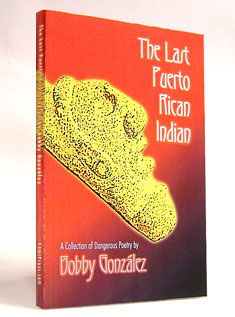
The Last Puerto Rican Indian


We are happy to announce the publication of a new book titled, The Last Puerto Rican Indian: A Collection of Dangerous Poetry by Bobby Gonzalez.

The Last Puerto Rican Indian, is a book of poetry that challenges the reader to confront preconceived notions about the history and contemporary struggles of the Native Peoples of the Americas. The book is the first title issued by the recently formed publishing company www.cemipress.com, which is a subsidiary of www.galeriacemi.com.

Bobby Gonzalez will be reading and signing his latest book on Thursday, June 22 at 6:30 PM at the Brooklyn YWCA located at 30 Third Avenue, Brooklyn, NY (between Atlantic Avenue and State Street in Boerum Hill, near the Downtown section of Brooklyn.). For information call:718-875-1190 Ext:223.

Mr Gonzalez will also be presenting his book on Friday, June 23 at 7:00 PM in the Bronx at El Maestro located at 700 Elton Avenue off 156th St. and Third Avenue, Bronx, NY.

Writing from the perspective of a modern Taino Indian, Mr. González takes on such varied themes as religious freedom (or lack thereof), cultural & physical genocide, violence against women, homophobia and the issue of racial/political identity.

“Dangerous memories.
Stolen histories.
Identity theft on a Cosmic
scale.

Who/what determines
Who/what we are?

The Last Puerto Rican
Indian,
with an abundance of love,
bites into a Cuban sandwich on the corner
of 145th Street and Brook Avenue.”
There are also verses that pay tribute to outstanding indigenous leaders such as Anacaona of Haiti, Guamá of Cuba, Cotubanamá from Quisqueya (the Dominican Republic), Sitting Bull of the Lakota and Osceola of the Seminole.
This unique volume contains many rare and intriguing graphic illustrations which document the lifeways, art and spirituality of Natives folk from the Amazon and the Caribbean. Most of these pictures are over one hundred years old and have not been viewed by most of the general public since the late 19th century.

An added bonus is a suggested Taino reading list which is a guide to both primary sources and current publications.

"The Last Puerto Rican Indian is beautifully written with a multiplicity of voices that capture both profound sadness and passionate defiance. Rich with spiritual meaning, Bobby Gonzalez brings us closer to the indigenous men, women and children of the Americas as he harmonizes between the past and the present, traveling great distances in time from before the conquest, through mass genocide and the resistance, to the contemporary and beyond. Affirming the enduring strength of our heritage, González declares, 'The Last Puerto Rican Indian has not yet been born.'" - Iris Morales, community activist/former Minister of Information, the Young Lords Party

Visit Bobby González' website at http://www.bobbygonzalez.com/

Saturday, June 10, 2006

Soca Warriors! Trinidad Pride at World Cup 2006

Fantastic! A thrilling match to watch as Trinidad's Soca Warriors, ranked 47th in the world, held off Sweden, ranked 16th, and that was with one man less than Sweden for almost the entire second half of the match today in Dortmund, Germany. This is the first time ever for Trinidad & Tobago at the World Cup, and they started their round in Group B undefeated. The match's final score of 0-0 earned them one point.

Back in January, Cristo Adonis, the shaman of the Carib community in Arima, Trinidad, told me that he and other members of the Carib community were called upon to perform a smoke ceremony for an inter-religious ceremony to bless the Soca Warriors on their path to the World Cup. They were the first to perform, in honour of their being Trinidad's first peoples. I am sure that Cristo will be beaming at the thought that his service may have somehow guided, blessed or otherwise aided the Warriors.


A Trinidadian fan welcomes the World Cup trophy to Trinidad

The Warriors themselves did a brilliant job: calm, confident, solid, professional, great control of the ball, perfect passing, none of the cry baby melodrama and fake dives (perhaps Sweden should take a hint about how real men play the game), precision and no prima donna attitudes. This is some of the best playing I have seen at the World Cup since I saw my first match back in 1978.

Congratulations Trinidad & Tobago! Let's see some more great play!

Tuesday, May 23, 2006

The Native "Terrorist": Anti-Indigenous Vocabulary in 2006

Please see: http://www.cbc.ca/news/viewpoint/yourspace/
caledonia_blockade.html
for some examples of what is referred to below.

From what I see on this page of letters from viewers, the CBC is doing an excellent job at upholding one side of the debate, particularly the viewpoints of those who continually seem to earn for themselves the right to be called "non-native." They earn that right in imposing themselves on the natives, by referring to their own laws, their civilization, their modernity, their money, their roads, and their Way, always in contrast to that of the natives. Any expression of indignation over being called "non-native" (i.e., white "Canadian") is possibly superficial, or worse, an attempt to take everything away from the natives, even their name.

For a country that prides itself on prosecuting hate crimes, I would imagine that some of the feedback posted on the CBC website comes close to hate speech, except that we in "Canada" tend to only really enforce anti-hate crime laws when it comes to the victims of someone else's holocaust in another continent. Genocide denial is quite tolerated here at home. Indeed, it seems that it is being taught, learned and recited.

I have been reading some letters on the CBC that speak of "our civilization" and how "we" have showered native peoples with modernity and progress. This is typical colonial discourse: without us, the white man, these natives would have all died; we brought them medicine; we brought them proper shelter; we brought them schools; we brought them jams and blankets. I had thought that only in Australia could one still hear such self-serving distortions of history, but that was obviously naive and unfair of me. In "Canada," we like to conveniently forget the Innu ("Canada's" own Tibet) and the countless communities that have been confined to living in filth, disease, unemployment and toxic pollution. We like to forget the unforgivably and uniquely high rates of tuberculosis in First Nations communities, the awful living conditions, the unbelievable rates of suicide. The United Nations--which we always claim to respect--routinely finds "Canada" at fault for grotesque living conditions on reserves that mirror if not rival those of any "third world" state.

Many "Canadian" non-native writers might also consider writing to thank President George W. Bush for providing them with their vocabulary: use of the words "terrorist," "our own home-grown terrorists," "appeasement," "hostages." When such words are used, it's only one option that the writers could be dreaming of, and that would be the total extermination of the natives.

In the past, I have provoked subscribers to The CAC Review to consider how the invasion of Iraq and 1492 mirror each other. I was soundly rebuked by some subscribers, who added to their protest that I was showing disrespect to those Native American soldiers who were risking their lives in battle in someone else's country. Now, the language of anti-terrorism, which sent Natives to fight natives, has been imported back from the grounds of colonial conquest, and is being leveled at native protesters here in North America. How did you not expect to see this discourse come back and tear your hind quarters to shreds? Pity those of us who cling to the dream that colonialism is a thing of the past.

What is Happening in "Canada"?

It is quite plain that the Six Nations protesters had taken down their barricade at Caledonia. The unnecessary, irrational, and provocative counter-barricade by some Caledonia residents has deliberately upset any plans for a peaceful settlement in the short term, which is clearly the aim of those hooligans. After years of pious, self-congratulatory Canadian comparisons to the United States, the way we congratulate ourselves on being a beacon of social justice, it is a relief to see the truth come out. Quite clearly, we are a colonial society with a deep substratum of ignorant, white racism still very much alive. "Canada," whatever that fiction is supposed to mean, reveals itself as an arbitrary construction of illegitmate power and abuse. At this point, anything the Six Nations people do to defend themselves is totally justified.
See http://www.cbc.ca/story/canada/national/2006/05/23/caledonia-monday.html for the latest news from the perspective of the state owned news media, and see also: http://sisis.nativeweb.org/actionalert/.